
Agilent Pesticides Analysis of Pesticides in Drinking Water Application Note

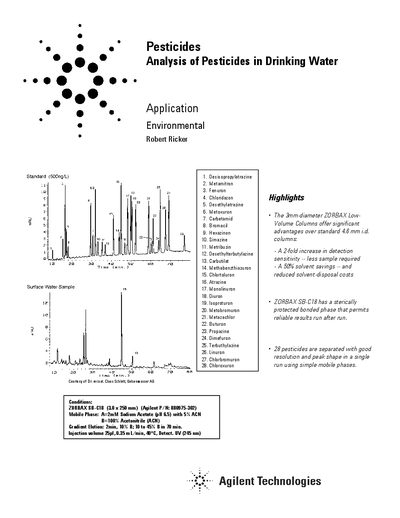
This document describes the use of a 3mm diameter ZORBAX Low-Volume Column for analysis of pesticides in drinking water. 28 pesticides are separated with good resolution and peak shape in a single run using simple mobile phases.

Agilent Pesticides Analysis of Pesticides in Drinking Water Application Note - cover page
Brand
Agilent
Document type
Application Note
Language
English
Pages
2
File format
PDF
File size
156 KB
Published
12 June, 2012
Updated
30 September, 2023
MD5 checksum
8FB4775EF162E556F904666C0B534F78

About this manual

A variety of pesticides are present in surface water at very low concentrations, requiring reliable analysis methods. High-Performance Liquid Chromatography (HPLC) with diode-array detection is an excellent tool for this purpose.

The document details a specific method developed by Dr. rer.nat. Claus Schlett that separates 28 pesticides in a single run using simple mobile phases and ZORBAX SB-C18 columns.

What's inside

  • Analysis of Pesticides
  • Drinking Water Regulations
  • HPLC Methodology
  • ZORBAX Columns
  • Mobile Phase Conditions

Frequently asked questions

What is the minimum detection limit for pesticides in drinking water according to this method?

Substances can be detected in concentrations less than 0.1 mg/L.

What is the total duration of the gradient elution procedure?

The gradient elution runs for a total of 72 minutes.

How many pesticides are separated in a single run?

Twenty-eight pesticides are separated with good resolution in a single run.

Download PDF (156 KB)

More Agilent Manuals


View all Agilent manuals →