
This document presents examples of useful differences in band spacing that can be obtained by varying column type while keeping mobile phase conditions constant. The stationary phase strength (retentivity) is in the order C8>Phenyl>CN for these sterically protected bonded phases. Long-term stability and reproducibility are provided by ZORBAX StableBond columns. A wide range of herbicides can be separated with excellent peak efficiency and peak shape.
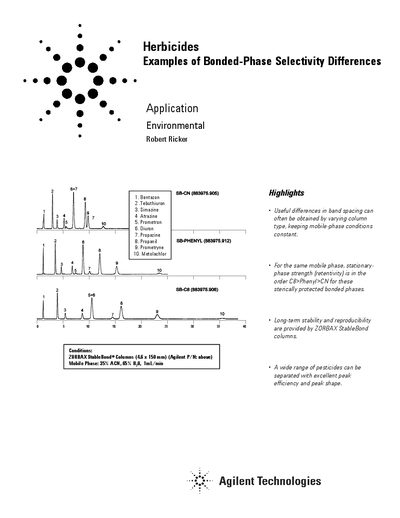
This document presents application examples for the separation of various herbicides using Agilent ZORBAX StableBond columns. It highlights the differences in band spacing and stationary-phase strength (retentivity) between CN, Phenyl, and C8 column types under constant mobile-phase conditions.
The text lists specific herbicides analyzed, including Bentazon, Tebuthiuron, Simazine, Atrazine, Prometron, Diuron, Propazine, Propanil, Prometryne, and Metolachlor. It notes that long-term stability and reproducibility are provided by these columns, allowing for the separation of a wide range of pesticides with excellent peak efficiency and shape.
| Column Dimensions | 4.6 x 150 mm |
|---|---|
| Mobile Phase Composition | 35% ACN, 65% H2O |
| Flow Rate | 1mL/min |
For the same mobile phase, stationary-phase strength (retentivity) is in the order C8>Phenyl>CN.
The examples include Bentazon, Tebuthiuron, Simazine, Atrazine, Prometron, Diuron, Propazine, Propanil, Prometryne, and Metolachlor.