
This datasheet provides features and characteristics of BS616LV2019, including operating voltage range, power consumption, access time, etc.
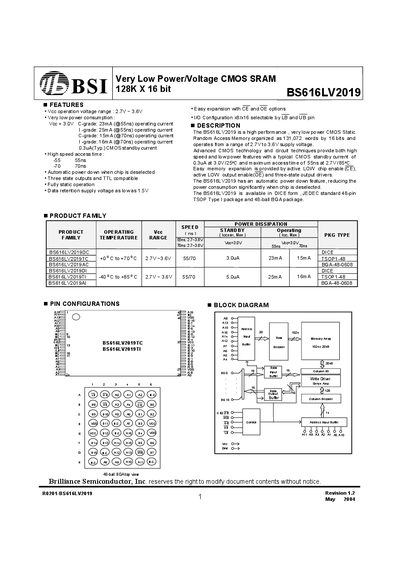
The document describes the BS616LV2019, a high-performance static random access memory (SRAM) organized as 131,072 words by 16 bits. It operates from a supply voltage range of 2.7V to 3.6V and features very low power consumption with a typical CMOS standby current of 0.3uA at 3.0V/25°C.
The device supports high-speed access times ranging from 55ns to 70ns depending on the grade and temperature conditions. It includes automatic power-down functionality when deselected, three-state outputs compatible with TTL logic, and fully static operation. The memory is available in DICE form (JEDEC standard 48-pin TSOP Type I) and a 48-ball BGA package.
| Organization | 131,072 words x 16 bits |
|---|---|
| Operating Voltage Range | 2.7V to 3.6V |
| Typical Standby Current (CMOS) | 0.3uA |
| Max Access Time (-grade) | 55ns |
| Package Types | DICE, TSOP1-48, BGA-48-0608 |
| Operating Temperature (Industrial) | -40°C to +85°C |
The typical CMOS standby current is 0.3uA at 3.0V/25°C.
The device operates from a supply voltage range of 2.7V to 3.6V.
Yes, it has an automatic power down feature that reduces power consumption when the chip is deselected.