
The ispGDS22/18/14 is a high-speed, flexible, in-system programmable Generic Digital Switch from Lattice Semiconductor. It can be used to reconfigure system signal routing, replace DIP switches, configure I/O boards' addresses, select clock sources, etc.
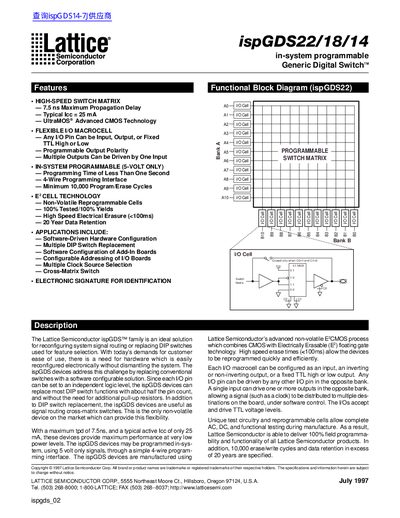
The Lattice ispGDS22/18/14 family provides a high‑speed switch matrix with a maximum propagation delay of 7.5 ns and low standby power (typical Icc = 25 mA). Each I/O pin can be configured as input, output, or fixed TTL level, enabling flexible routing and replacement of DIP switches.
Programming is performed via a 4‑wire TTL interface (MODE, SDI, SDO, SCLK) with less than one‑second programming time and a minimum of 10 000 program/erase cycles. The devices are available in plastic DIP and PLCC packages and feature non‑volatile E²CMOS cells with 20‑year data retention.
| Maximum Propagation Delay (tpd) | 7.5 ns |
|---|---|
| Standby Power (Icc) | 25 mA |
| Program/Erase Cycles | ≥10 000 |
| Data Retention | 20 years |
| Operating Temperature Range | 0 °C to 75 °C |
The maximum propagation delay is 7.5 ns.
The devices support a minimum of 10 000 program/erase cycles.
Programming uses a 4‑wire TTL interface (MODE, SDI, SDO, SCLK).
Typical standby current (Icc) is 25 mA.