
This datasheet lists the electrical characteristics of the MAZ7000 series zener diodes, including the maximum reverse voltage, maximum forward current, and maximum power dissipation
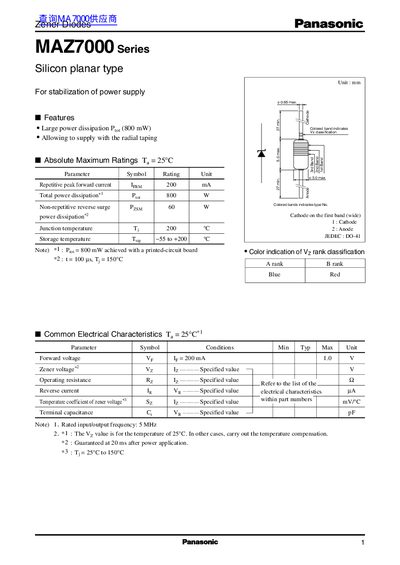
The MAZ7000 series Zener diodes from Panasonic are silicon planar devices designed for power‑supply stabilization. The series offers a wide range of Zener voltages from 4.8 V to 46 V, with color‑coded bands for easy identification.
The datasheet provides absolute maximum ratings, typical forward and reverse characteristics, and detailed part‑number tables. Key parameters such as power dissipation, peak forward current, reverse surge capability, and temperature ranges are listed for each device variant.
| Maximum Power Dissipation (Pmax) | 800 mW |
|---|---|
| Repetitive Peak Forward Current | 200 mA |
| Non‑repetitive Reverse Surge Power | 60 W |
| Junction Temperature (Tj) | 200 °C |
| Storage Temperature Range | -55 °C to +200 °C |
| Rated Input/Output Frequency | 5 MHz |
The series can dissipate up to 800 mW.
The rated frequency is 5 MHz.
The junction temperature rating is 200 °C.
They can be stored from –55 °C up to +200 °C.