
Dinghao is a website that provides current stock inventory, technical data, encyclopedia information, and hot news
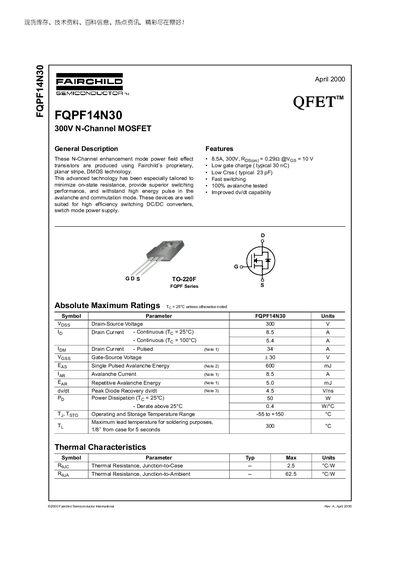
The FQPF14N30 MOSFET is a 300 V N‑Channel enhancement mode power transistor built with Fairchild’s planar stripe DMOS technology. It offers low on‑resistance, low gate charge, and fast switching, making it suitable for high‑efficiency DC‑DC converters and switch‑mode power supplies.
The datasheet provides detailed electrical characteristics, absolute maximum ratings, typical performance curves, and package dimensions (TO‑220F). It also includes trademark information, safety notices, and product status definitions.
| Drain‑Source Voltage (VDS) | 300 V |
|---|---|
| Continuous Drain Current (ID) @ 25 °C | 8.5 A |
| Pulsed Drain Current (ID) @ 100 °C | 34 A |
| Gate‑Source Voltage (VGS) | ±30 V |
| On‑Resistance (RDS(on)) @ VGS=10 V | 0.299 Ω |
| Typical Gate Charge (Qg) | 30 nC |
| Power Dissipation (PD) @ 25 °C | 50 W |
| Junction‑to‑Case Thermal Resistance | 2.5 °C/W |
| Package | TO‑220F |
The device is rated for a maximum drain‑source voltage of 300 V.
It can conduct up to 8.5 A continuously at 25 °C.
The typical gate charge is about 30 nC.
The MOSFET is offered in a TO‑220F package.