
This document describes the features and characteristics of Micron's 1Gb DDR SDRAM products, including voltage, data storage mode, clock inputs, command inputs, data transmission mode, etc.
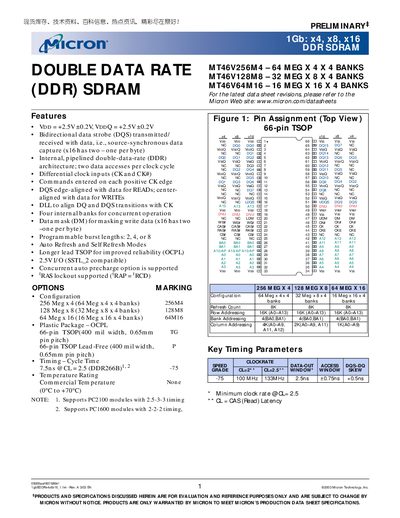
The 1Gb DDR SDRAM is a high‑speed CMOS memory device internally organized as a quad‑bank DRAM. It uses a double‑data‑rate architecture with a 2n‑prefetch design, delivering two data words per clock cycle. The device supports x4, x8, and x16 data widths and operates with a differential clock (CK/CK#).
Key features include programmable burst lengths of 2, 4, or 8, auto‑precharge, self‑refresh, and SSTL_2‑compatible I/O. The part is offered in a 66‑pin TSOP package (standard OCPL or lead‑free) with a 7.5 ns cycle time (DDR266) and a commercial temperature rating of 0 °C to +70 °C.
| Package | 66‑pin TSOP (400 mil width, 0.65 mm pitch) |
|---|---|
| Cycle Time | 7.5 ns @ CL=2.5 (DDR266) |
| Burst Lengths | Programmable 2, 4, or 8 |
| Supply Voltage | VDD = 4.2 V ±0.5 V, VDDQ = +2.5 V |
| Capacity Options | 1 Gb: 256 M×4, 128 M×8, 64 M×16 |
It supports programmable burst lengths of 2, 4, or 8.
The device is offered in a 66‑pin TSOP package, both standard OCPL and lead‑free versions.
It operates with a 7.5 ns cycle time, corresponding to DDR266 (133 MHz).