
Key facts
- Brand
- Analog Devices
- Model
- SSM2142
- Industry
- Industrial
- Documents
- 3
- Languages
- EN
- Last added
- 2012-08-01
Start here
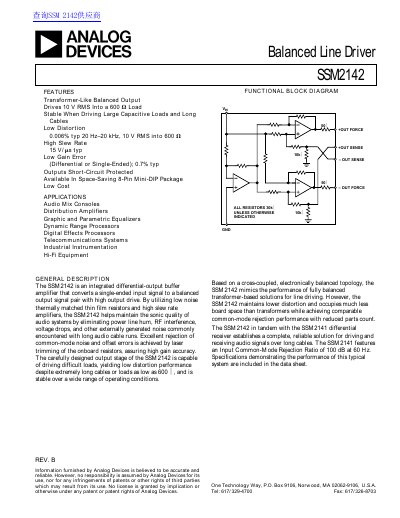
Analog Devices SSM2142 Balanced Line Driver Datasheet
The Analog Devices SSM2142 is an integrated differential-output buffer amplifier that converts a single-ended input signal to a balanced output signal pair. It utilizes low noise thermally matched thin film resistors and high slew rate amplifiers to maintain sonic quality in audio systems by eliminating power line hum, RF interference, and voltage drops commonly encountered with long cable runs.
The device mimics the performance of fully balanced transformer-based solutions for line driving while occupying less board space and achieving comparable common-mode rejection. It is capable of driving difficult loads, including those as low as 600 Ω, yielding low distortion performance despite extremely long cables.
Analog Devices SSM2142 specifications
| Output Drive Capability | 10 V RMS into a 600 Ω Load |
|---|---|
| Total Harmonic Distortion Plus Noise (THD+N) | 0.006% typ |
| Slew Rate | 15 V/µs typ |
| Gain Error (Differential) | 0.7% typ |
| Input Impedance | 10 kΩ |
| Supply Current (Unloaded) | 5.5 mA typ |
| Operating Temperature Range | -40°C to +85°C |
Source: Analog Devices SSM2142 Balanced Line Driver Datasheet
All Analog Devices SSM2142 documents by type
Ratings, dimensions and ordering codes, for selection and design work.
Questions answered in these manuals
What is the primary application of the SSM2142?
The SSM2142 is designed for use in audio mix consoles, distribution amplifiers, graphic and parametric equalizers, dynamic range processors, digital effects processors, telecommunications systems, industrial instrumentation, Hi-Fi equipment, and as a balanced line driver.
Is the SSM2142 stable when driving large capacitive loads?
Yes, the device is designed to be stable when driving large capacitive loads and long cables without requiring snubber networks or series load resistors.
What is the typical slew rate of the SSM2142?
The device has a typical slew rate of 15 V/µs.
How much load can the SSM2142 drive?
It can drive a 10 V RMS signal into a 600 Ω load while maintaining low distortion.
What is the typical THD+N performance of the SSM2142?
The device achieves a typical total harmonic distortion plus noise of 0.006 % from 20 Hz to 20 kHz.