
CDC303 is an eight-bit divide-by-two circuit/clock driver from TI. The device has low output skew and pulse skew, with a maximum output skew of 1ns and a maximum pulse skew of 1ns. CDC303's inputs and outputs are TTL-compatible. The device is available in plastic small-outline (D) package and standard plastic (N) 300mil DIP packages.
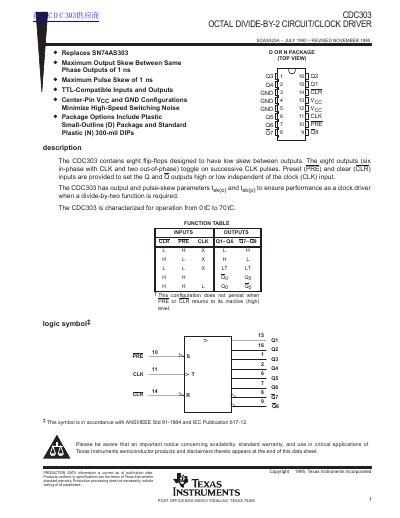
The CDC303 is an octal divide-by-2 circuit and clock driver containing eight flip-flops designed to have low skew between outputs. It features six in-phase outputs and two out-of-phase outputs that toggle on successive clock pulses. The device includes preset and clear inputs to set outputs independent of the clock and is characterized for operation from 0°C to 70°C.
| Operating Temperature Range | 0°C to 70°C |
|---|---|
| Supply Voltage | 4.5 V to 5.5 V |
| Maximum Output Skew | 1 ns |
| Maximum Pulse Skew | 1 ns |
| High-Level Output Current | -24 mA |
| Low-Level Output Current | 48 mA |
Yes, the recommended operating supply voltage range is 4.5V to 5.5V.
The device is characterized for operation up to 70°C.
The maximum input clock frequency is 80 MHz.
The maximum supply voltage is 5.5 V.