
This document describes the features and characteristics of the FDT86113LZ N-Channel PowerTrench® MOSFET, including the maximum on-state resistance, high-performance trench technology, high power and current handling capability, and ESD protection level.
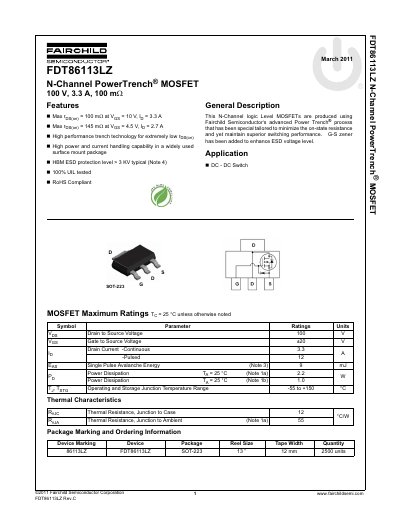
This document is a datasheet for the Fairchild Semiconductor FDT86113LZ, an N-Channel logic level MOSFET produced using the Power Trench process. The device is designed for high performance with low on-state resistance and is available in the SOT-223 surface mount package.
The datasheet provides maximum ratings, electrical characteristics, and typical performance curves. Key specifications include a drain to source voltage of 100V, a continuous drain current of 3.3A, and an on-resistance of 100 mΩ at Vgs = 10V. It also details thermal characteristics, capacitance values, and switching parameters.
| Package Type | SOT-223 |
|---|
The device supports a maximum continuous drain current of 3.3 A.
The maximum power dissipation is 2.2 W when the ambient temperature is 25°C.
The operating and storage junction temperature ranges from -55 to +150 °C.