
This document describes the features and characteristics of the BZB984 series voltage regulator double diodes, including maximum power dissipation, VZ tolerance, ultra small package, etc. This product is suitable for general regulation functions and ESD and surge protection.
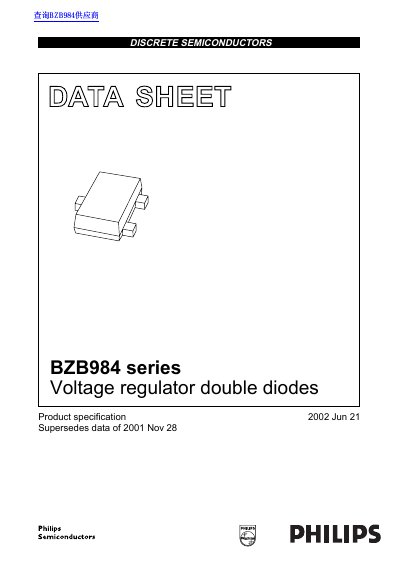
The document is a product specification sheet for the BZB984 series of low-power voltage regulator diodes. These devices are housed in an ultra-small flat plastic SOT663 surface-mount device (SMD) package. They feature a total power dissipation of up to 425 mW and offer approximately 5% V Z tolerance, making them suitable for general regulation functions as well as ESD and surge protection applications.
| Total power dissipation (2 diodes loaded) | 425 mW |
|---|---|
| Working voltage range | 2.4 to 15 V |
| Package type | SOT663 |
| Continuous forward current | - 200 mA |
| Forward voltage (typical) | See Table per type |
The maximum total power dissipation is 425 mW when both diodes are loaded at an ambient temperature of 25°C.
The only recommended soldering method for the SOT663 package is reflow soldering.
Thermal resistance from junction to ambient is 294 K/W for two loaded diodes and 472 K/W for one loaded diode.