
The DS90CF383 is a +3.3V LVDS transmitter from National Semiconductor Corporation that supports a 24-bit Flat Panel Display (FPD) Link, and uses a 65 MHz transmit clock to sample 28 bits of input data per cycle and transmit it at a rate of 455 Mbps per LVDS data channel.
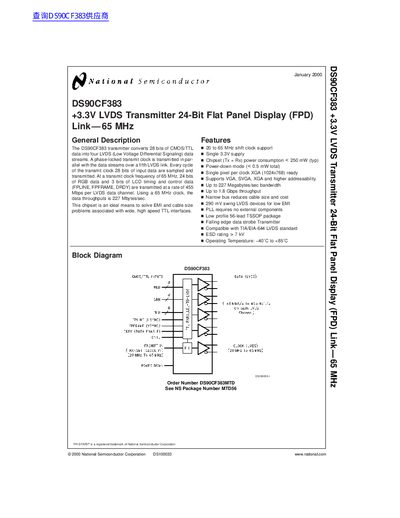
The DS90CF383 is a +3.3V LVDS transmitter designed for 24-bit Flat Panel Display (FPD) links operating at 65 MHz. It converts 28 bits of CMOS/TTL input data into four LVDS data streams, with a phase-locked transmit clock transmitted in parallel over a fifth LVDS link. At 65 MHz, it transmits 24 bits of RGB data and 3 bits of LCD timing and control data at a rate of 455 Mbps per channel, achieving a total data throughput of 227 Mbytes/sec.
| Supply Voltage | 3.0V to 3.6V |
|---|---|
| Operating Temperature | -40°C to +85°C |
| Clock Frequency | 20 to 65 MHz |
| Data Throughput | 227 Mbytes/sec |
| Package Type | 56-lead TSSOP |
| ESD Rating | >7k V |
The device supports shift clock frequencies from 20 MHz to 65 MHz.
Using a 65 MHz clock, the data throughput is 227 Mbytes/sec.
No, the input and control inputs accept 3.3V TTL/CMOS levels and are not 5V tolerant.