
This document describes the features and characteristics of the BF998 silicon N-channel MOSFET tetrode. It is a short-channel transistor with a high S/C quality factor, suitable for low-noise, gain-controlled input stages up to 1 GHz. It is an electrostatic discharge sensitive device, and handling precautions must be observed.
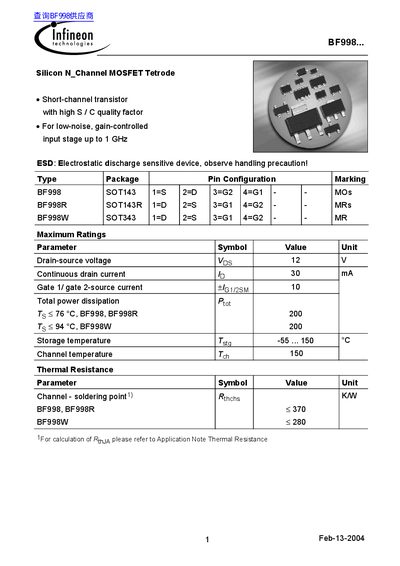
This document is a technical datasheet for the Philips BF998, a silicon N-channel MOSFET tetrode designed for low-noise, gain-controlled input stages operating up to 1 GHz. The device features high S/C quality factor and includes specific handling precautions due to its sensitivity to electrostatic discharge (ESD).
The datasheet provides comprehensive electrical characteristics including DC parameters such as breakdown voltages and leakage currents, AC parameters like transconductance and capacitance at various frequencies, and power gain figures. It also lists maximum ratings for voltage, current, and temperature, along with thermal resistance data.
| Continuous drain current | 30 mA |
|---|---|
| Storage temperature range | -55 ... 150 °C |
| Gate 1 source breakdown voltage (min) | 8 V |
| Forward transconductance (typical) | 24 mS |
| Maximum power gain at 800 MHz | 20 dB |
The device is suitable for low-noise, gain-controlled input stages up to 1 GHz.
Yes, it is an ESD (Electrostatic discharge) sensitive device and requires careful handling.