
The BTS 7750 G is a low-RDS ON, high-performance quad D-MOS switch driver that can be configured as a bridge or quad switch, optimized for DC motor management applications. It features low static current, small package and full protection.
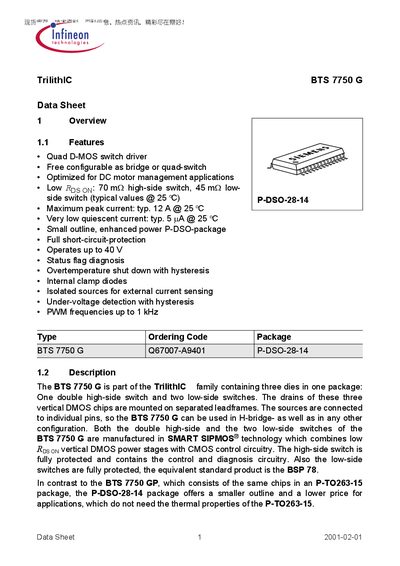
The BTS 7750 G is a quad D‑MOS switch driver from Infineon's TrilithIC family, offering a double high‑side switch and two low‑side switches in a compact P‑DSO‑28‑14 package. It is optimized for DC motor management and can be configured as a bridge or quad‑switch.
Key features include low on‑resistance, very low quiescent current, short‑circuit, over‑temperature, and undervoltage protection, as well as status flag diagnosis. The device operates up to 40 V and supports PWM frequencies up to 1 kHz, making it suitable for motor‑control applications.
| Maximum peak current | typ. 12 A @ 25 °C |
|---|---|
| Low on‑resistance (R_on) high‑side | 70 mΩ (typical) |
| Low on‑resistance (R_on) low‑side | 45 mΩ (typical) |
| Quiescent current | typ. 5 pA @ 25 °C |
| Operating voltage range | 3 V to 42 V |
| Status output pull‑up voltage | 5.4 V |
The device can deliver a typical peak current of 12 A at 25 °C.
The IC contains one double high‑side switch and two low‑side switches.
The quiescent current is typically 5 pA at 25 °C.