
This document describes a method for separating local anesthetics on different bonded-phase ZORBAX columns and analyzes the selectivity of the separations.
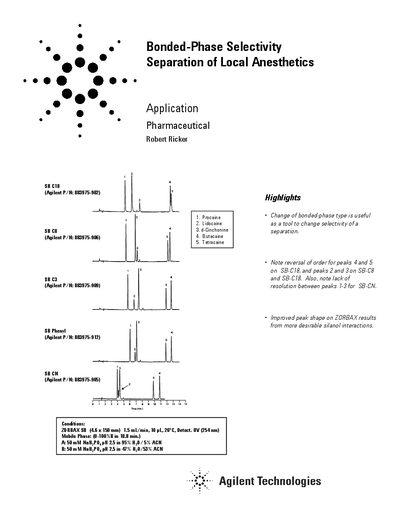
This document presents an application for the separation of local anesthetics (Procaine, Lidocaine, d-Cinchonine, Butacaine, and Tetracaine) using different Agilent bonded-phase columns. It compares the performance of SB C18, SB C8, SB C3, SB Phenyl, and SB CN columns.
| Column Dimensions | 4.6 x 150 mm |
|---|---|
| Flow Rate | 1.5 mL/min |
| Detection Wavelength | 254 nm |
| Mobile Phase A | 50 mM NaH2PO4, pH 2.5 in 95% H2O/ 5% ACN |
| Mobile Phase B | 50 mM NaH2PO4, pH 2.5 in 47% H2O/53% ACN |
Changing the bonded-phase type is useful as a tool to change the selectivity of a separation.
Improved peak shape on ZORBAX results from more desirable silanol interactions.