
This document describes a method for separating DNPH-derivative aldehydes using reversed-phase chromatography, which can detect very low concentrations of aldehydes.
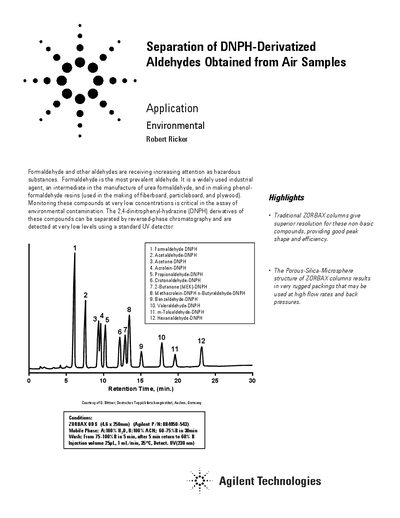
This document details a method for separating and detecting formaldehyde and other aldehydes obtained from air samples. The compounds are derivatized with 2,4-dinitrophenyl-hydrazine (DNPH) and analyzed via reversed-phase chromatography using a standard UV detector.
The note provides specific chromatographic conditions utilizing ZORBAX ODS columns, including mobile phase composition, flow rates, temperature, and injection volume. It lists eleven specific aldehydes that can be resolved under these conditions.
The method separates formaldehyde, acetaldehyde, acetone, acrolein, propionaldehyde, crotonaldehyde, 2-butanone, methacrolein, n-butyraldehyde, benzaldehyde, valeraldehyde, m-tolualdehyde, and hexanaldehyde.