
This Application Note describes four separation strategies for purifying compounds from non-baseline separated peaks.
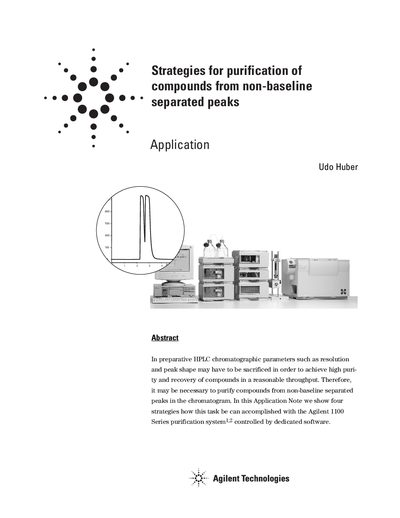
In preparative HPLC, chromatographic parameters such as resolution and peak shape may be sacrificed to achieve high purity and recovery. This document presents four strategies to accomplish this task with the Agilent 1100 Series purification system controlled by dedicated software.
The four strategies described are: peak-based fraction collection with a high threshold setting; peak-based fraction collection using up- and down-slope parameters; peak-based fraction collection with time slicing of the peak; and mass-based fraction collection. The text details the equipment used, including Agilent 1100 Series pumps, autosamplers, detectors, and collectors.
| Software Versions | ChemStation rev. A.09.01, Purification/HighThruput rev. A.01.01 |
|---|---|
| Column Dimensions | 21.2 x 150 mm, 5 µm |
| Flow Rate | 20 mL/min |
The system is controlled using the Agilent ChemStation and the Purification/HighThruput software.
The method achieves a recovery of over 90% for Compound 2.
A well fills up every six seconds under these conditions.