
This document introduces the LC/MS detection method of LSD.
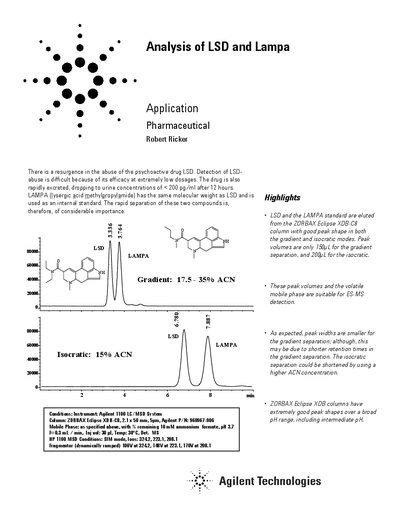
This document details a method for the detection and separation of LSD and its internal standard, LAMPA (lysergic acid methylpropylamide). The method utilizes an Agilent 1100 LC/MSD system equipped with a ZORBAX Eclipse XDB-C8 column to achieve rapid separation of these compounds, which is critical due to the low dosages and rapid excretion of LSD.
| Column | ZORBAX Eclipse XDB-C8, 2.1 x 50 mm, 5pm |
|---|---|
| Column Part Number | 960967-906 |
| Mobile Phase Additive | 10 mM ammonium formate, pH 3.7 |
| Flow Rate | 0.3 mL / min |
| Injection Volume | 30 pl |
| Column Temperature | 30°C |
| Detection Mode | SIM mode |
| LSD Ion | 324.2 |
| LAMPA Ion | 223.1 |
| Internal Standard Ion | 208.1 |
LAMPA (lysergic acid methylpropylamide) is used as an internal standard because it has the same molecular weight as LSD.
Peak volumes are 150uL for the gradient separation and 200uL for the isocratic separation.
The ZORBAX Eclipse XDB-C8 column is recommended for good peak shape over a broad pH range.