
This document introduces the features of Agilent's StableBond bonded phases, including low pH, high temperature compatibility, and a wide range.
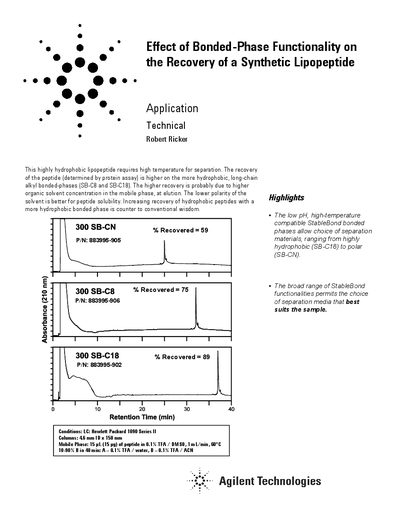
This document presents an application study by Robert Ricker regarding the separation and recovery of a highly hydrophobic synthetic lipopeptide. The study compares different StableBond bonded phases to determine which offers the best peptide recovery under specific conditions.
The results indicate that more hydrophobic, long-chain alkyl bonded-phases (specifically SB-C8 and SB-C18) yield higher recovery rates compared to polar phases like SB-CN. This is attributed to higher organic solvent concentrations in the mobile phase at elution, which improves peptide solubility despite being counter-intuitive to conventional wisdom.
The SB-C18 bonded phase achieves a recovery of 89%.
High temperature is required for the separation of this highly hydrophobic lipopeptide.
The separation conditions use a column with an inner diameter of 4.6 mm.