
This article introduces the Statistical Peak Identification feature in Agilent Technologies' Cerity NDS for Chemical QA/QC, which addresses the complications in traditional peak identification algorithms caused by peak shifts, changes in concentration, and external forces. It provides a more robust quantitation.
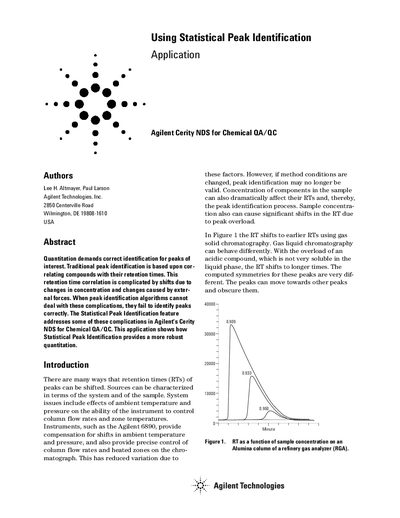
Traditional peak identification methods relying solely on retention time correlation often fail when shifts occur due to changes in concentration, ambient conditions, or external forces. This document introduces the Statistical Peak Identification (SPID) feature in Agilent's Cerity NDS for Chemical QA/OC, which addresses these complications to provide more robust quantitation.
The note details the implementation of SPID, which utilizes peak symmetry and area information from a user-defined Data Pool to correct misidentifications. It includes a practical example using a Refinery Gas Analyzer (RGA) to show how SPID successfully identifies components across a wide concentration range where conventional methods fail due to peak overload and retention time shifts.
It provides more robust quantitation by addressing complications like retention time shifts caused by concentration changes or external forces.
The algorithm uses peak symmetry and area information for each compound in the calibration table.
The user must enter at least one correctly identified sample into the SPID Data Pool and enable the feature.