
This document describes the method for the detection of β-lactam antibiotics in milk. These antibiotics are widely used in veterinary medicine for the treatment and prevention of diseases. The presence of residues in milk and edible tissues can cause problems in fermentation processes and health issues for individuals hypersensitive to β-lactams. To protect consumers, maximum residue limits (MRL) were set in EU regulation 2377/90. For milk, these values range from 4 µg/kg for penicillin G, ampicillin, and amoxicillin to 30 µg/kg for dicloxacillin, cloxacillin, and oxacillin. Screening is usually performed using microbiological and immunological methods. Confirmation, however, requires an independent physicochemical technique. Therefore, a highly sensitive LC/MS/MS method was developed for the detection of penicillins in milk samples.
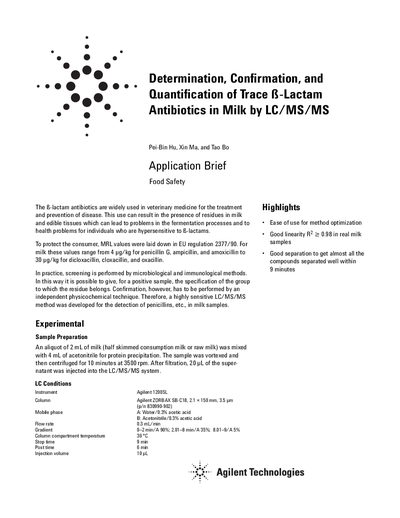
This document outlines a highly sensitive LC/MS/MS method developed for the detection of beta-lactam antibiotics, such as penicillins, in milk samples. The method addresses the need for physicochemical confirmation of residues found via screening, ensuring compliance with MRL values set by EU regulation 2377/90.
| Flow rate | 0.3 mL/min |
|---|---|
| Column compartment temperature | 30 °C |
| Injection volume | 10 pl |
| Drying gas temperature | 350 °C |
| Drying gas flow | 10 L/min |
An aliquot of 2 mL of milk is mixed with 4 mL of acetonitrile for protein precipitation, vortexed, and centrifuged for 10 minutes at 3500 rpm.
The flow rate is set to 0.3 mL/min.
The column compartment temperature is maintained at 30 °C.
The drying gas temperature is 350 °C.