
A method for the detection and quantification of 2,4,6-Trichloroanisole in wine at a concentration as low as 1 ppt was developed using the Agilent 7890A/7000 Series Triple Quadrupole GC/MS with a Pressure Controlled Tee configuration.
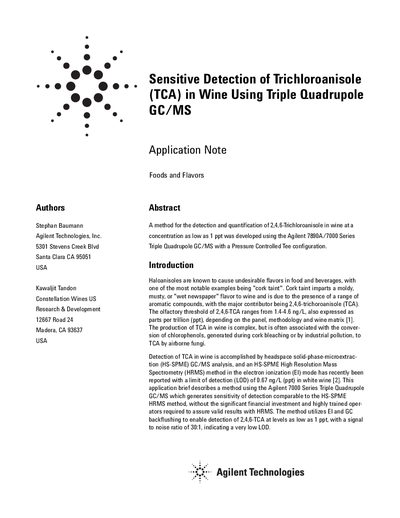
The document details a method developed by Agilent Technologies and Constellation Wines US for the sensitive detection and quantification of 2,4,6-Trichloroanisole (TCA) in wine. The primary target is to detect TCA at concentrations as low as 1 part per trillion (ppt), which corresponds to the olfactory threshold for cork taint.
The method utilizes an Agilent 7890A Gas Chromatograph coupled with a 7000 Series Triple Quadrupole GC/MS featuring a Triple-Axis Detector. Key technical aspects include the use of headspace solid-phase microextraction (HS-SPME), electron ionization (EI) mode, and a backflushing configuration to minimize interferences. The application demonstrates that this setup achieves a signal-to-noise ratio greater than 30:1 at 1 ng/L, providing sensitivity comparable to High Resolution Mass Spectrometry (HRMS) methods.
| Detection Limit | 1 ppt (ng/L) |
|---|---|
| Signal-to-Noise Ratio | >30:1 |
| Calibration Range | 1 to 20 ng/L |
| Calibration Correlation Coefficient | R² = 0.993 |
| Column Type | Agilent J&W HP-5ms UI |
| Source Temperature | 300 °C |
The method uses an Agilent 7890A/7000 Series Triple Quadrupole GC/MS with a Pressure Controlled Tee configuration.
It provides sensitivity comparable to HS-SPME HRMS without the need for significant financial investment or highly trained operators.