
The BFG197 is a silicon NPN transistor produced by Philips Semiconductors. It features high power gain and low noise figure. The transistor is packaged in a 4-pin, dual-emitter plastic SOT143 envelope and is primarily intended for wideband applications in the GHz range, such as satellite TV systems and repeater amplifiers in fibre-optic systems.
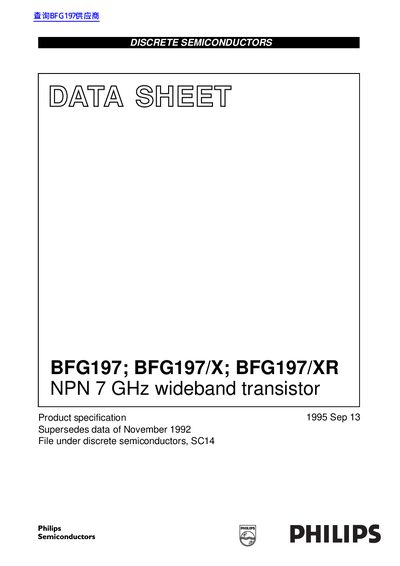
The Philips BFG197 series consists of silicon NPN transistors available in a 4-pin dual-emitter plastic SOT143 envelope. These devices are primarily intended for wideband applications in the GHz range, such as satellite TV systems and repeater amplifiers in fiber-optic systems. Key features include high power gain, low noise figure, and gold metallization for excellent reliability.
The document provides detailed electrical characteristics, including collector-base voltage, transition frequency, and maximum unilateral power gain. It also includes limiting values, thermal characteristics, SPICE parameters for circuit simulation, and package outlines for the SOT143 and SOT143R variants.
| Package type | 4-pin, dual-emitter plastic SOT143 envelope |
|---|---|
| Collector-base voltage (VCBO) | 20 V |
| Collector-emitter voltage (VCEO) | 10 V |
| Collector current (IC) | 100 mA |
| Total power dissipation (Ptot) | 350 mW |
| Transition frequency (fT) | 7.5 GHz |
| Maximum unilateral power gain (GUM) | 16 dB |
| Noise figure (F) | 1.7 dB |
| Storage temperature range (Tstg) | -65 to +150 °C |
They are primarily intended for wideband applications in the GHz range, such as satellite TV systems and repeater amplifiers in fibre-optic systems.
The maximum continuous DC collector current is 100 mA.
The transition frequency is 7.5 GHz when the collector current is 50 mA and VCE is 4 V.