
This article describes a method for quantitative measurement of the cardiac glycoside, Digoxin, in human plasma using a Varian 1200L LC/MS/MS system in the negative ion detection mode. This method is capable of detecting Digoxin levels as low as 15 picograms.
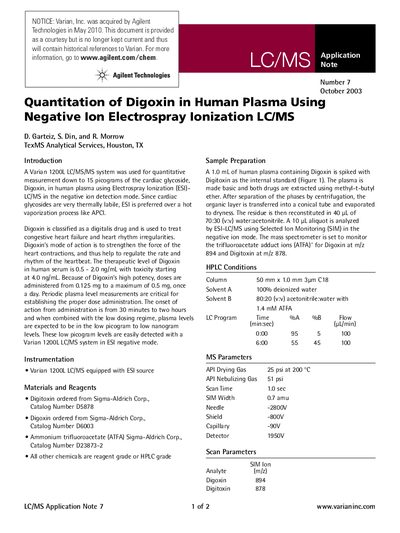
This document details a method for the quantitative measurement of the cardiac glycoside Digoxin in human plasma. The method utilizes a Varian 1200L LC/MS/MS system operating in negative ion Electrospray Ionization (ESI) mode to detect Digoxin down to 15 picograms. The technique is preferred over hot vaporization processes like APCI because cardiac glycosides are thermally labile.
| Detection Limit | 15 picograms |
|---|---|
| Therapeutic Level | 0.5 - 2.0 ng/mL |
| Column Dimensions | 50 mm x 1.0 mm |
| Drying Gas Temperature | 200 °C |
| Detection Mode | Negative Ion ESI |
The method achieves quantitative measurement down to 15 picograms of Digoxin.
ESI is preferred because cardiac glycosides are very thermally labile and would decompose in hot vaporization processes.
The therapeutic level is between 0.5 and 2.0 ng/mL, with toxicity starting at 4.0 ng/mL.