
This document demonstrates the femtogram sensitivity of the antipsychotic drugs Raclopride and Ritanserin using the Varian 1200L LC/MS/MS in selected reaction monitoring mode (SRM). Ritanserin is a serotonin-2 antagonist drug shown to be effective in the treatment of anxiety and depression, while Raclopride acts as a dopamine D2 receptor antagonist. The document also provides information on the instrumentation and sample preparation methods used in the study.
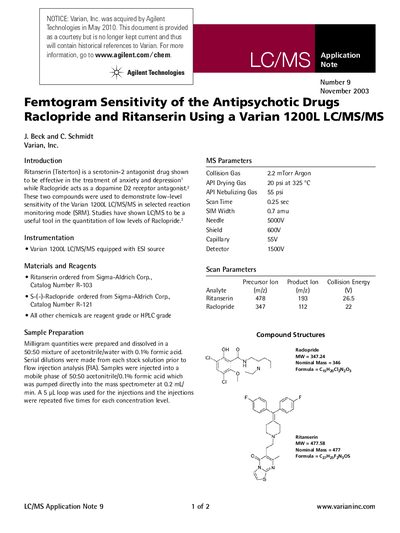
This document details an analytical method to demonstrate the low-level detection capabilities of the Varian (now Agilent) 1200L LC/MS/MS instrument. The study focuses on two specific antipsychotic drugs: Ritanserin, a serotonin-2 antagonist, and Raclopride, a dopamine D2 receptor antagonist.
The note outlines the instrumentation setup, including ESI source parameters such as collision gas, drying gas, and nebulizing gas settings. It describes sample preparation involving serial dilutions in acetonitrile/water mixtures with formic acid. The document presents results showing detection limits of 100 pg/mL for Raclopride (500 fg on-column) and 10 pg/mL for Ritanserin (50 fg on-column), confirming the system's ability to achieve reproducible results at femtogram levels.
At the lowest concentration of 100 pg/mL, the S/N ratio is approximately 10:1.