
Analysis of Chloramphenicol in Shrimp by LC/MS/MS
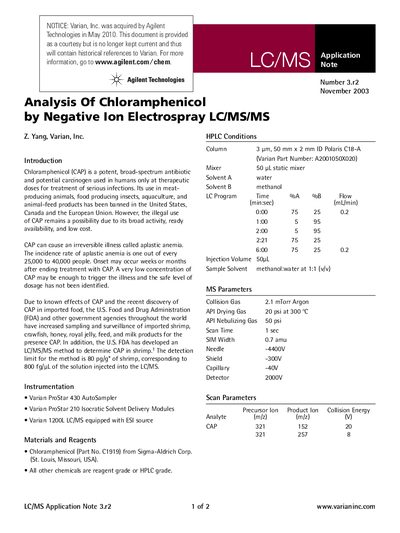
This application note details a method for analyzing chloramphenicol (CAP) in food products, specifically shrimp, using Liquid Chromatography-Tandem Mass Spectrometry (LC/MS/MS). The document notes that while CAP use in food-producing animals is banned in the US, Canada, and EU, illegal use remains a possibility, prompting increased surveillance by agencies like the FDA. The method utilizes a Varian ProStar 430 Autosampler and Varian 1200L LC/MS equipped with an ESI source to detect CAP at low concentrations.
| Detection Limit (Shrimp) | <3 pg/g |
|---|---|
| Detection Limit (Solution) | <30 fg/uL |
| Column Dimensions | 50 mm x 2 mm ID |
| Column Particle Size | 3 um |
| Flow Rate | 0.2 mL/min |
| Injection Volume | 50 uL |
| Retention Time | 3.1 minutes |
| Collision Energy | 20 V |
The limit of detection is estimated to be less than 3 pg/g in shrimp.
The analysis uses precursor ion 321 and product ions 152 and 257.
Chloramphenicol gives a retention time of 3.1 minutes.