
This document describes two ionization methods, electrospray ionization (ESI) and atmospheric pressure chemical ionization (APCI), for molecular weight determination using a liquid chromatography/mass spectrometry (LC/MS) system. ESI is suitable for ionization of a wide variety of compounds, while APCI is used for compounds that do not ionize well with ESI. The document also provides the molecular formulas and molecular weights of two compounds.
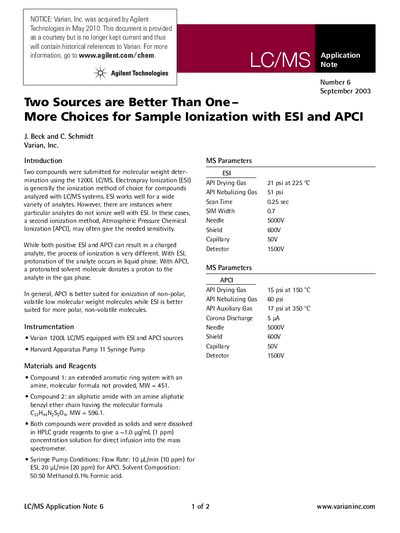
The document discusses two ionization methods, ESI and APCI, used with the Varian 1200L LC/MS. It explains that while ESI is generally preferred for polar analytes, APCI offers better sensitivity for non-polar, volatile low molecular weight molecules where ESI fails to provide adequate signal.
The note presents experimental results using two specific compounds dissolved in HPLC grade reagents. Compound 1 showed a strong protonated ion signal with ESI but a very weak signal with APCI. Conversely, Compound 2 produced no signal with ESI but a distinct molecular ion peak when analyzed via APCI.
The flow rate for ESI is 10 pL/min.
The flow rate for APCI is 20 pL/min.
The drying gas pressure for APCI is 15 psi.