
This study evaluated the performance of the Agilent 1260 Infinity Analytical SFC system for the analysis of thiourea in two model compounds. The results showed excellent linearity, repeatability, and limits of detection.
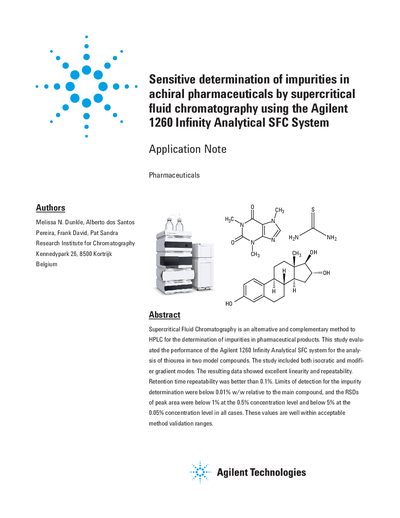
This document evaluates the performance of the Agilent 1260 Infinity Analytical SFC System for the analysis of impurities in pharmaceutical products. The study focuses on the detection of thiourea in two model compounds, caffeine and estriol, using both isocratic and gradient modes.
The analysis demonstrated excellent linearity and repeatability, with retention time repeatability better than 0.1%. Limits of detection for impurity determination were found to be below 0.01% w/w relative to the main compound, confirming the system's suitability for standard SFC applications.
| Detection | DAD, 254 nm for caffeine; DAD, 220 nm for estriol |
|---|
The limits of detection for impurity determination were below 0.01% w/w relative to the main compound.
The retention time repeatability was better than 0.1%.
The study evaluated the performance using thiourea in two model compounds: caffeine and estriol.