
The document describes a semiconductor chip used for driving magnets, motors, or other loads. The chip is designed for application in motor vehicles and operates in a temperature range of -40°C to 130°C. It contains two amplifiers with a typical open-loop voltage gain of 80 dB. The input stages are PNP differential amplifiers, resulting in a common-mode input voltage range from 0V to approximately the value of VS and a maximum input differential voltage of VS. To achieve low saturation voltages in the sink circuit, the drive circuit of the sink transistor is connected to the supply voltage. The chip also features an SOA protective circuit to protect against ground short-circuits. The source transistors are turned off at chip temperatures above approximately 160°C.
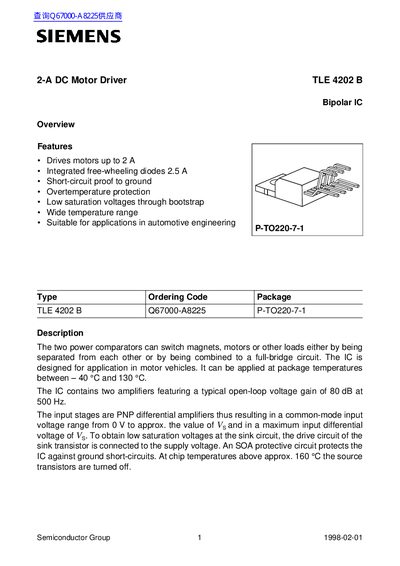
The Siemens TLE 4202 B is a Bipolar IC designed specifically for applications in automotive engineering. It functions as a two-channel DC motor driver capable of driving motors up to 2A. The device features integrated free-wheeling diodes, short-circuit proof circuitry to ground, and overtemperature protection.
| Supply Voltage (Vs) | -40 to 17 V |
|---|---|
| Output Current (Sink Transistors) | -2.5 A |
| Diode Peak Currents to Ground | -2.5 A |
| Junction Temperature (Tj) | -150 °C |
| Package Type | P-TO220-7-1 |
The case temperature during operation ranges from -40 °C to 130 °C depending on supply voltage.
Yes, the IC is designed for application in motor vehicles.
Yes, it includes an SOA protective circuit that protects the IC against ground short-circuits.