
This document introduces the method for detecting antibiotics using the Agilent Polaris™ 5µ C18-A, 50 x 2.0mm column
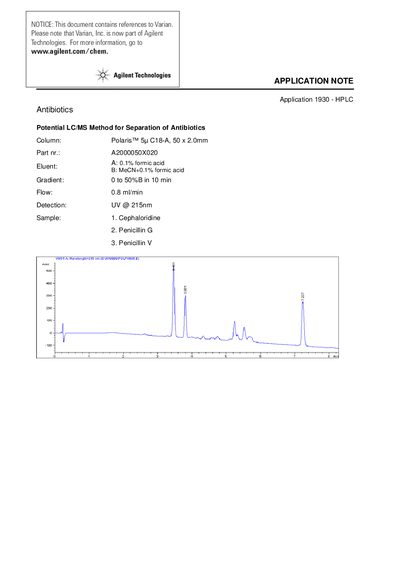
This document is an application note detailing a High Performance Liquid Chromatography (HPLC) method for the separation of antibiotics. It is published by Agilent Technologies, noting that Varian, Inc. is now part of the company.
The specific method utilizes a Polaris 5 C18-A column with dimensions of 50 x 2.0mm. The eluent consists of a mixture containing formic acid, with a gradient increasing from 0 to 50% B over 10 minutes at a flow rate of 0.8 ml/min. Detection is performed using UV at 215nm.
| Column | Polaris 5 C18-A, 50 x 2.0mm |
|---|---|
| Part number | A2000050xX020 |
| Eluent | a MoGNs0-194 formic acid |
| Gradient | 0 to 50%B in 10 min |
| Flow | 0.8 ml/min |
| Detection | UV @ 215nm |
The application specifies using a Polaris™ 5 C18-A column with dimensions of 50 x 2.0mm.
The stated procedure requires a flow rate of 0.8 ml/min.