
This application note describes a method for analyzing ginsenosides using an Agilent 1200 series liquid chromatograph.
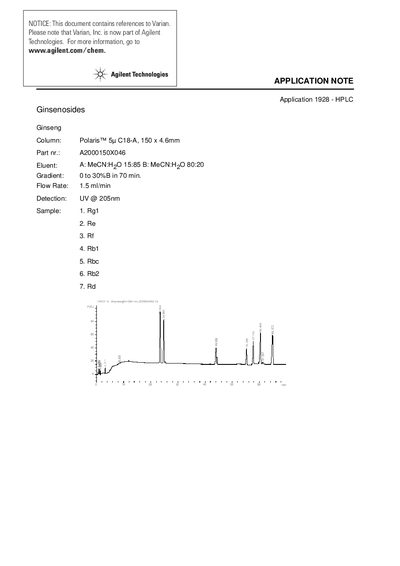
This document provides an HPLC analytical procedure specifically designed for the separation and detection of ginsenosides in ginseng samples. The method utilizes a Varian (now Agilent) Polaris™ 5y C18-A column with dimensions of 150 x 4.6mm.
The analysis employs a gradient elution starting from 0% to 30% organic modifier over 70 minutes, with a flow rate of 1.5 ml/min. Detection is performed using UV absorbance at a wavelength of 205nm.
| Column Type | Polaris™ 5y C18-A, 150 x 4.6mm |
|---|---|
| Eluent A Composition | MeCN:H90 15:85 |
| Eluent B Composition | MeCN:H20 80:20 |
| Gradient Program | 0 to 30%B in 70 min. |
| Flow Rate | 1.5 ml/min |
| Detection Wavelength | UV @ 205nm |
The method uses a Polaris™ 5y C18-A column with dimensions of 150 x 4.6mm.
Detection is performed using UV absorbance at a wavelength of 205nm.