
Varian LC App Note 25 Detection of N-Methylcarbamate Pesticides by HPLC EPA Method 531.1

This document describes a high-performance liquid chromatography method that uses fluorescence detection following post-column derivatization for enhanced sensitivity and selectivity. This method has become the method of choice for the analysis of carbamate residues in both food and water.
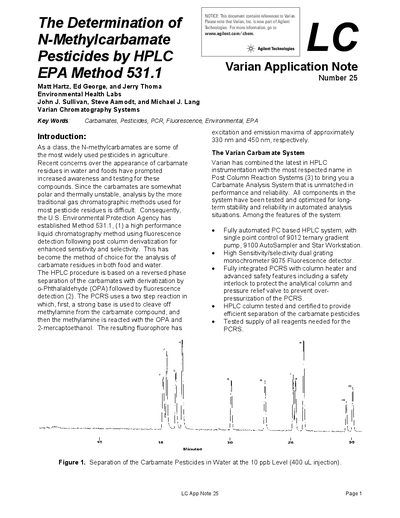

Varian LC App Note 25 Detection of N-Methylcarbamate Pesticides by HPLC EPA Method 531.1 - cover page
Brand
Agilent
Document type
Application Note
Language
English
Pages
2
File format
PDF
File size
121 KB
Published
12 June, 2012
Updated
30 September, 2023
MD5 checksum
C3FA919996378C3E4286F749856FBEA5

About this manual

The document details an HPLC procedure for analyzing carbamate residues, which are polar and thermally unstable, making them difficult to analyze via gas chromatography. The method utilizes reversed-phase separation followed by post-column reaction with o-Phthalaldehyde (OPA) and 2-mercaptoethanol, detected by fluorescence.

What's inside

  • Introduction
  • The Varian Carbamate System
  • Analytical Conditions
  • System Performance
  • Comparison of EPA and Varian Methods

Frequently asked questions

What is the detection limit for the Varian system when analyzing carbamate pesticides in water?

The system provides detection limits at or below 1 ppb for common carbamate pesticide residues.

How long does it take to separate all carbamate compounds in the provided chromatogram?

All of the compounds are well resolved within 30 minutes.

What is the retention time for the analyte Aldicarb in the system?

The retention time for Aldicarb is 23.2 minutes.

Download PDF (121 KB)

More Agilent Manuals


View all Agilent manuals →