
This article introduces a simple scale-up method for a 940-LC analytical to preparative HPLC using a linear scale-up factor to change flow rate, column size and sample injection volume to produce an effective preparative HPLC separation.
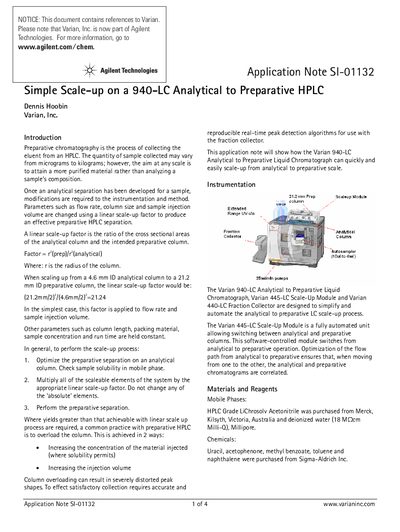
The document explains how to scale up from analytical to preparative chromatography using a linear scale-up factor based on column radius ratios. It details the process of optimizing analytical separations and adjusting flow rates, injection volumes, and column sizes to achieve effective preparative separations.
| Column ID (Preparative) | 21.2 mm |
|---|---|
| Column ID (Analytical) | 4.6 mm |
| Flow rate (Analytical) | 1.0 mL/min |
| Flow rate (Preparative) | 21.2 mL/min |
| Sample injection volume (Analytical) | 20 uL |
| Mobile phase ratio | 60:40 Acetonitrile/H2O |
| Tube size | 50 mL |
The factor is the ratio of the cross sectional areas of the analytical column and the intended preparative column, calculated as r'(prep)/r'(analytical).
Peak purity is determined by re-injecting fractions on an analytical Liquid Chromatograph with a PDA detector and comparing them to a spectral library.