
Agilent Technologies application note, introduces the HPLC separation of flavonoids in Ginkgo Biloba using Polaris™ 5µ C18-A column, flow rate 1.0 ml/min, detection wavelength 254nm.
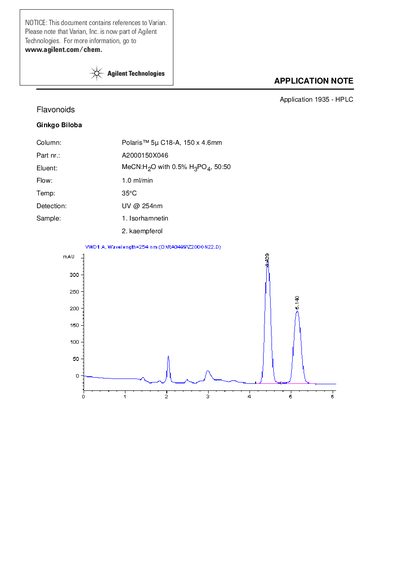
This document provides an HPLC method for the analysis of flavonoids in Ginkgo Biloba samples. The procedure utilizes a Polaris 5y C18-A column with dimensions of 150 x 4.6mm.
The analysis employs a mobile phase consisting of MeCN:H2O with 0.5% H3PO4 in a 50:50 ratio. The flow rate is set to 1.0 ml/min at a temperature of 35°C. Detection is performed using a VWD4 detector at a wavelength of 254 nm.
| Column | Polaris 5y C18-A, 150 x 4.6mm |
|---|---|
| Part Number | A2000150X046 |
| Eluent | MeCN:H2O with 0.5% H3PO4, 50:50 |
| Flow Rate | 1.0 ml/min |
| Temperature | 35°C |
| Detection | UV @ 254nm |
The document lists Isorhamnetin and kaempferol as the specific samples analyzed.
The detection is performed at a wavelength of 254 nm.