
This document is the datasheet of FRONT-MSTB 2,5/ 2-ST-5,08 from PHOENIX CONTACT GmbH & Co. KG. It mainly introduces the product's brand, model, product name, color, rated current, rated voltage, thread, connection type and other information.
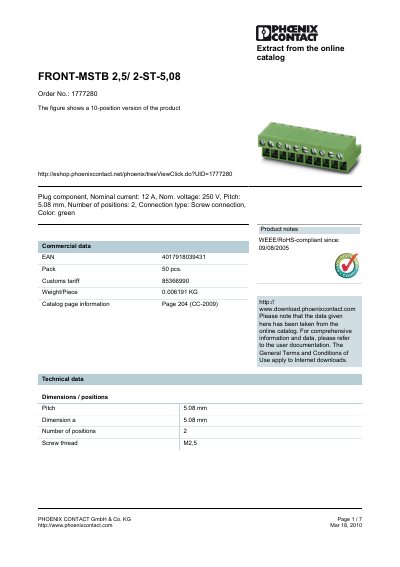
The FRONT-MSTB 2,5/2-ST-5,08 is a 2‑position terminal block with a 5.08 mm pitch and screw‑connection type. It is rated for 12 A nominal current and 250 V nominal voltage, and complies with RoHS and WEEE standards. Technical data include insulating material group I, rated surge voltage of 4 kV, and a range of permissible conductor cross‑sections.
The document also lists accessories such as removal aids and marker cards, and shows the product’s certifications (CB, CSA, CUL, GOST, UL, VDE‑PZI). Ordering information, commercial data, and dimensions are provided for easy integration into industrial wiring projects.
| Nominal current | 12 A |
|---|---|
| Nominal voltage | 250 V |
| Pitch | 5.08 mm |
| Number of positions | 2 |
| Connection type | Screw connection |
| Insulating material group | I |
| Rated surge voltage | 4 kV |
| Certifications | CB, CSA, CUL, GOST, UL, VDE‑PZI |
The terminal block is rated for a nominal current of 12 A.
The pitch is 5.08 mm.
It is certified by CB, CSA, CUL, GOST, UL and VDE‑PZI.
It uses a screw connection.