
The MAX9377/MAX9378 are fully differential, high-speed, low-jitter anything-to-LVPECL and anything-to-LVDS translators, respectively, with a selectable divide-by-four function. Low propagation delay and high speed make them ideal for various high-speed network routing and backplane applications at speeds up to 2GHz in nondivide mode. The MAX9377/MAX9378 accept any differential input signal within the supply rails and with minimum amplitude of 100mV. Inputs are fully compatible with the LVDS, LVPECL, HSTL, and CML differential signaling standards. The MAX9377 outputs are LVPECL and have sufficient current to drive 50Ω transmission lines. The MAX9378 outputs are LVDS and conform to the ANSI EIA/TIA-644 LVDS standard. The MAX9377/MAX9378 are available in 8-pin µMAX packages and operate from a single +3.3V supply over the -40°C to +85°C temperature range.
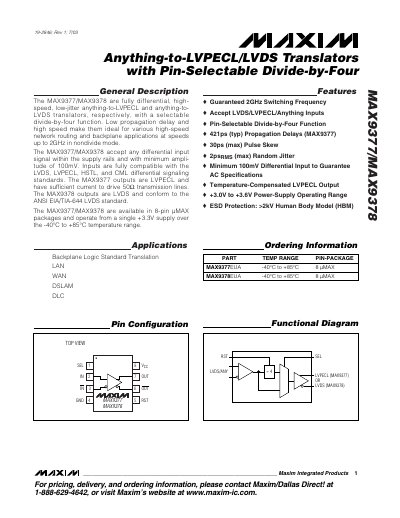
The MAX9377 and MAX9378 are fully differential, high‑speed, low‑jitter translators that convert any differential input signal to LVPECL (MAX9377) or LVDS (MAX9378) outputs. They accept LVDS, LVPECL, HSTL, and CML input standards and operate from a single +3.3 V supply over –40 °C to +85 °C, making them suitable for backplane and high‑speed network routing applications up to 2 GHz.
Key features include a pin‑selectable divide‑by‑four function, propagation delays as low as 421 ps, output drive capability of 50 mA (LVPECL) or 100 mA (LVDS), and extensive ESD protection. The datasheet provides absolute maximum ratings, DC and AC electrical characteristics, typical operating curves, pin descriptions, and layout recommendations for maintaining signal integrity.
| Supply Voltage Range | +3.0 V to +3.6 V |
|---|---|
| Operating Temperature Range | -40 °C to +85 °C |
| Minimum Differential Input Amplitude | 100 mV |
| Propagation Delay (typical) | 421 ps |
| Output Current (LVPECL) | 50 mA |
| Output Current (LVDS) | 100 mA |
| Divide‑by‑Four Function | Pin‑selectable via SEL input |
The devices accept LVDS, LVPECL, HSTL, and CML differential signaling standards.
The SEL pin selects divide‑by‑four when high; low disables division.
Both parts operate from a single supply of +3.0 V to +3.6 V.