
MAX9121/MAX9122 are four-channel low-voltage differential signaling (LVDS) differential line receivers ideal for applications requiring high data rates, low power, and low noise. The MAX9121/MAX9122 are guaranteed to receive data at speeds up to 500Mbps (250MHz) over controlled-impedance media of approximately 100Ω. The transmis-sion media may be printed circuit (PC) board traces or cables. The MAX9121/MAX9122 accept four LVDS differential inputs and translate them to LVCMOS outputs. The MAX9122 features integrated parallel termination resis-tors (nominally 107Ω), which eliminate the requirement for four discrete termination resistors and reduce stub lengths. The MAX9121 inputs are high impedance and require an external termination resistor when used in a point-to-point connection. The devices support a wide common-mode input range of 0.05V to 2.35V, allowing for ground potential differences and common-mode noise between the driver and the receiver. A fail-safe feature sets the output high when the inputs are open, or when the inputs are undriven and shorted or parallel terminated. The EN and EN inputs con-trol the high-impedance output. The enables are common to all four receivers. Inputs conform to the ANSI TIA/EIA-644 LVDS standard. Flow-through pinout simplifies PC board layout and reduces crosstalk by separating the LVDS inputs and LVCMOS outputs. The MAX9121/MAX9122 operate from a single +3.3V supply, and are specified for operation from -40°C to 85°C.
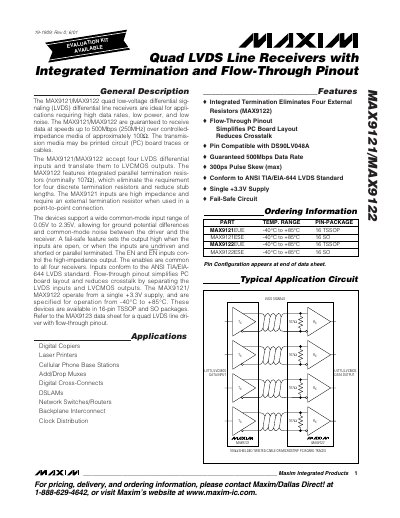
The MAX9121 and MAX9122 are quad LVDS line receivers that convert four differential LVDS inputs to LVCMOS outputs. They operate from a single +3.3 V supply, support a common‑mode input range of 0.05 V to 2.35 V, and include a fail‑safe feature that forces the output high when inputs are open or undriven. The MAX9122 integrates 107 Ω parallel termination resistors, while the MAX9121 requires external termination.
These devices are intended for high‑speed, low‑power applications such as digital copiers, laser printers, base stations, and network switches. They are offered in 16‑pin TSSOP and SO packages and are rated for operation from –40 °C to +85 °C.
| Maximum data rate | 500 Mbps (250 MHz) |
|---|---|
| Supply voltage | +3.3 V |
| Operating temperature range | -40 °C to +85 °C |
| Package types | 16‑pin TSSOP, 16‑pin SO |
| Common‑mode input range | 0.05 V to 2.35 V |
The devices can receive data at speeds up to 500 Mbps (250 MHz).
Both parts operate from a single +3.3 V supply.
They are specified for operation from –40 °C to +85 °C.