
The MAX9375 is a high-performance, low-latency LVDS/Anything-to-LVPECL translator from Maxim that supports signal rates up to 2GHz. It is ideal for various high-speed network routing and backplane applications. The MAX9375 is available in an 8-pin µMAX package and operates from a single +3.3V supply over the -40°C to +85°C temperature range.
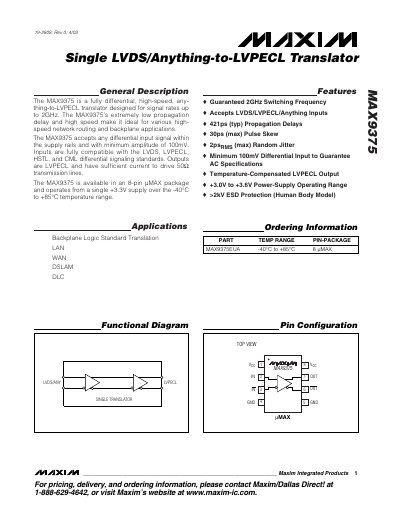
The MAX9375 is a fully differential, high‑speed translator that converts any differential input signal (LVDS, LVPECL, HSTL, CML) to LVPECL output. It is intended for high‑speed network routing, backplane and other applications requiring low propagation delay and fast edge rates.
Key features include operation from a single +3.3 V supply over –40 °C to +85 °C, minimum input amplitude of 100 mV, propagation delay of about 421 ps, and LVPECL outputs capable of driving 50 Ω transmission lines when properly terminated.
| Switching Frequency | 2.0‑2.5 GHz |
|---|---|
| Propagation Delay (typ) | 421 ps |
| Minimum Differential Input Amplitude | 100 mV |
| Supply Voltage | +3.3 V (operates from a single +3.3V supply) |
| Output Drive Impedance | 50 Ω transmission lines |
| Operating Temperature Range | -40 °C to +85 °C |
| ESD Protection (Human Body Model) | ≥2 kV |
The device supports switching frequencies up to 2 GHz, with a specified range of 2.0‑2.5 GHz.
It operates from a single 3.3 V supply, with an allowed range of +3.0 V to +3.6 V.
A minimum differential input amplitude of 100 mV is required.
Terminate each LVPECL output with a 50 Ω resistor to VCC‑2 V (or an equivalent Thevenin termination).