
The MAX3880 is an integrated deserializer with clock recovery from Texas Instruments, which converts 2.488Gbps serial data to 16-bit-wide, 155Mbps parallel data for SDH/SONET applications. The device operates at a single +3.3V supply and accepts high-speed serial-data inputs and delivers low- voltage differential-signal (LVDS) parallel clock and data outputs for interfacing with digital circuitry. The MAX3880 includes a low-power clock recovery and data retiming function for 2.488Gbps applications. The fully integrated phase-locked loop (PLL) recovers a synchronous clock signal from the serial NRZ data input; the signal is then retimed by the recovered clock. The MAX3880’s jitter performance exceeds all SDH/SONET specifications. An additional 2.488Gbps serial input is available for system loopback diagnostic testing. The device also includes a TTL-compatible loss-of-lock (LOL) monitor and LVDS synchronization inputs that enable data realignment and reframing. The MAX3880 is available in the extended temperature range (-40°C to +85°C) in a 64-pin TQFP-EP (exposed pad) package.
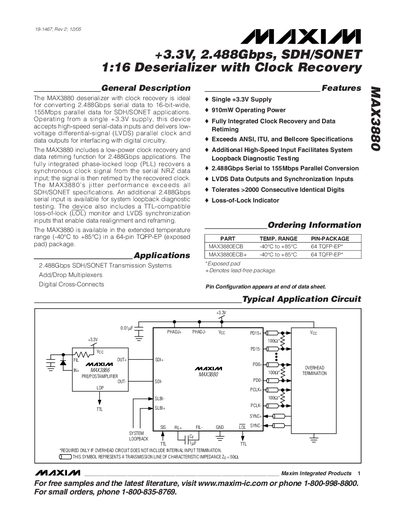
The MAX3880 deserializer converts a 2.488 Gbps serial data stream to a 16‑bit‑wide, 155 Mbps parallel output for SDH/SONET applications. It operates from a single +3.3 V supply, includes a fully integrated PLL for clock recovery and data retiming, and provides LVDS clock and data outputs.
The device offers low power consumption (≈910 mW), high jitter performance, a loss‑of‑lock monitor, and optional system loopback testing. It is supplied in a 64‑pin TQFP‑EP package rated for –40 °C to +85 °C.
| Operating Power | 910 mW |
|---|---|
| Serial Data Rate | 2.488 Gbps |
| Parallel Output Data Rate | 155.52 Mbps |
| Temperature Range | -40 °C to +85 °C |
| Package | 64‑pin TQFP‑EP |
| Jitter Tolerance (≥1 MHz) | 0.46 UI |
| Bit Error Rate (BER) | < 1 × 10⁻¹⁰ |
It operates from a single +3.3 V supply.
The device supports a serial data rate of 2.488 Gbps.
It is offered in a 64‑pin TQFP‑EP (exposed pad) package for the –40 °C to +85 °C temperature range.