
The MAX3890 serializer is an ideal device for converting 16-bit-wide, 155Mbps parallel data to 2.5Gbps serial data in ATM and SDH/SONET applications. It operates from a single +3.3V supply and accepts low-voltage differential-signal (LVDS) clock and data inputs to interface with high-speed digital circuitry, delivering positive-referenced emitter-coupled logic (PECL) serial data and clock outputs. The device features a fully integrated phase-locked loop (PLL) that synthesizes an internal 2.5GHz serial clock from a 155.52MHz, 77.76MHz, 51.84MHz, or 38.88MHz reference clock. A loopback data output is provided for system diagnostic testing. The MAX3890 is available in a 64-pin TQFP exposed-pad (EP) package, suitable for extended temperature range (-40°C to +85°C) applications.
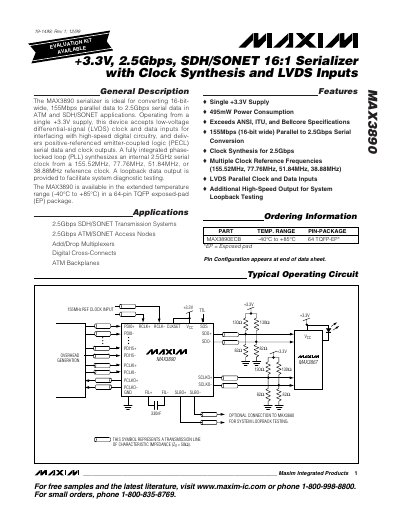
The MAX3890 is a 16‑bit‑wide serializer designed for ATM and SDH/SONET applications. It operates from a single +3.3 V supply, accepts LVDS clock and data inputs, and provides PECL serial data and clock outputs. An integrated PLL synthesizes a 2.5 GHz serial clock from selectable reference frequencies (155.52 MHz, 77.76 MHz, 51.84 MHz, or 38.88 MHz). The device also includes a system loopback feature for diagnostic testing.
The serializer is offered in a 64‑pin TQFP‑EP package suitable for extended temperature operation (‑40 °C to +85 °C). Detailed electrical characteristics, pin descriptions, and layout recommendations are provided to aid designers in implementing the MAX3890 in high‑speed digital systems.
| Supply Voltage | +3.3 V (single) |
|---|---|
| Power Consumption | 495 mW |
| Operating Temperature Range | -40 °C to +85 °C |
| Package | 64‑pin TQFP‑EP |
| Data Conversion | 16‑bit 155 Mbps parallel to 2.5 Gbps serial |
| Clock Reference Frequencies | 155.52 MHz, 77.76 MHz, 51.84 MHz, 38.88 MHz |
| LVDS Inputs | Differential LVDS clock and data |
| PECL Outputs | Positive‑referenced emitter‑coupled logic (PECL) serial data and clock |
It operates from a single +3.3 V supply.
The device works from –40 °C up to +85 °C.
Four frequencies are supported: 155.52 MHz, 77.76 MHz, 51.84 MHz, and 38.88 MHz.
It is supplied in a 64‑pin TQFP with an exposed pad (TQFP‑EP).