
The MAX9326 low-skew, 1:9 differential driver features extremely low output-to-output skew (50ps max) and part-to-part skew (225ps max)
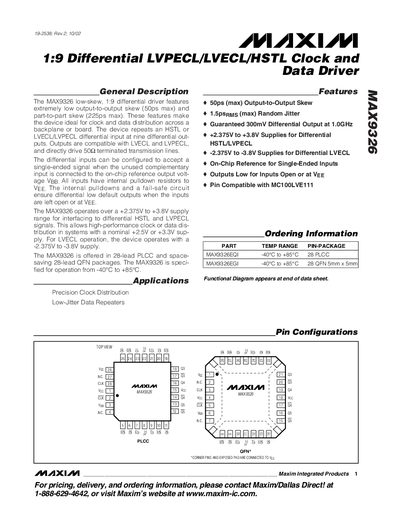
The MAX9326 low‑skew, 1:9 differential driver provides extremely low output‑to‑output skew (50 ps max) and part‑to‑part skew (225 ps max), making it suitable for high‑performance clock and data distribution across backplanes or boards. It supports LVPECL, LVECL, and HSTL signaling and can operate from a +2.375 V to +3.8 V supply.
The device is offered in 28‑lead PLCC and 28‑lead QFN packages, operates over –40 °C to +85 °C, and includes on‑chip reference circuitry for single‑ended operation. Detailed electrical characteristics, pin descriptions, and package dimensions are provided in the datasheet.
| Output‑to‑Output Skew | 50 ps max |
|---|---|
| Random Jitter | 1.5 ps RMS |
| Supply Voltage Range | +2.375 V to +3.8 V |
The maximum output‑to‑output skew is 50 ps.
It operates from a supply voltage of +2.375 V to +3.8 V.