
This document describes the features and characteristics of the Dual Input Network Clock Generator/Synchronizer AD9549 Rev. D. It features flexible reference inputs, input frequencies ranging from 8 kHz to 750 MHz, two reference inputs, loss of reference indicators, auto and manual holdover modes, auto and manual switchover modes, smooth A-to-B phase transition, excellent stability in holdover mode, programmable 16 + 1-bit input divider and feedback divider, multiple output frequencies, programmable digital loop filter, high speed digitally controlled oscillator (DCO) core, direct digital synthesizer (DDS) with integrated 14-bit DAC, excellent dynamic performance, and software controlled power-down.
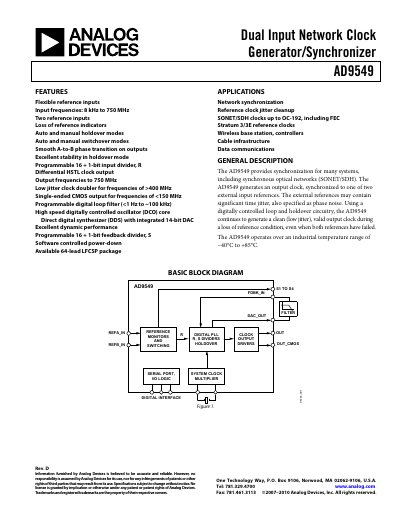
The AD9549 provides a dual‑input network clock generator/synchronizer with flexible reference inputs ranging from 8 kHz to 750 MHz. It supports automatic and manual holdover, switchover modes, and offers programmable dividers, digital loop filter, and a direct digital synthesizer for low‑jitter output clocks.
The device operates over an industrial temperature range (‑40 °C to +85 °C) and is supplied by multiple analog and digital rails (e.g., AVDD3 = 3.3 V ± 5%). It delivers up to 750 MHz output frequency, with power dissipation up to ~1.3 W in full‑load conditions. Detailed pin configurations, electrical specifications, and timing parameters are provided for system integration.
| Reference Input Frequency Range | 8 kHz to 750 MHz |
|---|---|
| Output Frequency Range | up to 750 MHz |
| Supply Voltage (AVDD3) | 3.3 V ± 5% |
| Operating Temperature Range | ‑40 °C to +85 °C |
The AD9549 can generate output clocks up to 750 MHz.
It operates from –40 °C to +85 °C.
The reference inputs accept frequencies from 8 kHz up to 750 MHz.