
AD9520-5 is an AD company's clock generator product. It supports external 3.3V/5V VCO/VCXO to 2.4GHz, supports 1 differential or 2 single-ended reference inputs, supports CMOS, LVDS or LVPECL references to 250MHz, supports 16.67MHz to 33.3MHz crystal reference input, supports optional reference clock doubler, supports reference monitoring function, supports automatic and manual reference switching/holdover mode, supports selectable reverse/non-reverse switching, supports glitch-free reference switching, supports automatic recovery from holdover mode, supports digital or analog lock detection, supports optional zero delay operation, supports 12 1.6GHz LVPECL outputs, each output can be divided into 4 groups, each group of 3 outputs has a 1-to-32 divider with phase delay, output jitter is as low as 225fs rms, the channel-to-channel skew of grouped outputs is less than 16ps, each LVPECL output can be programmed as CMOS or LVPECL output.
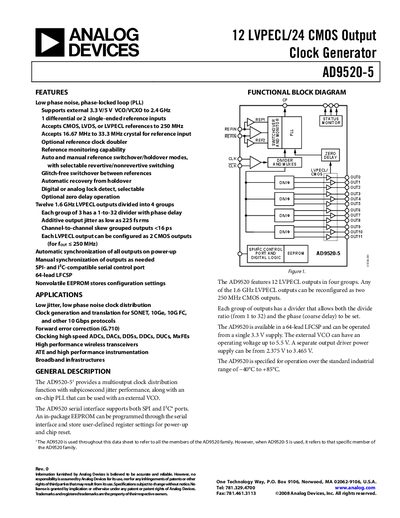
The AD9520-5 provides a multi‑output clock distribution function with sub‑picosecond jitter performance. It supports external VCO/VCXO up to 2.4 GHz, offers twelve LVPECL outputs (grouped in four sets) that can be reconfigured as CMOS outputs, and includes programmable dividers, zero‑delay operation and automatic reference switchover.
The device is controlled via an SPI‑ or I²C‑compatible serial port and stores configuration settings in an on‑package EEPROM. It operates from a single 3.3 V supply over the industrial temperature range (‑40 °C to +85 °C) and is supplied in a 64‑lead LFCSP package.
| Number of LVPECL outputs | 12 |
|---|---|
| Maximum output frequency | 2400 MHz |
| Supply voltage (VS) | 3.135 V – 3.465 V |
| Reference input frequency range | 0 – 250 MHz |
| Reference input sensitivity | 280 mV p‑p |
| Channel‑to‑channel skew (grouped outputs) | <16 ps |
| Additive output jitter | 225 fs rms |
It operates from a 3.3 V supply, with the VS pin ranging from 3.135 V to 3.465 V.
The device provides twelve LVPECL outputs, arranged in four groups of three.
Each output can generate frequencies up to 2.4 GHz.
The AD9520-5 can be programmed via SPI or I²C compatible serial ports.