
CZL-1 type resistance strain gauge load cell is used for portable car scale, has high sensitivity, high accuracy, high stability, high repeatability, low zero drift and other characteristics.
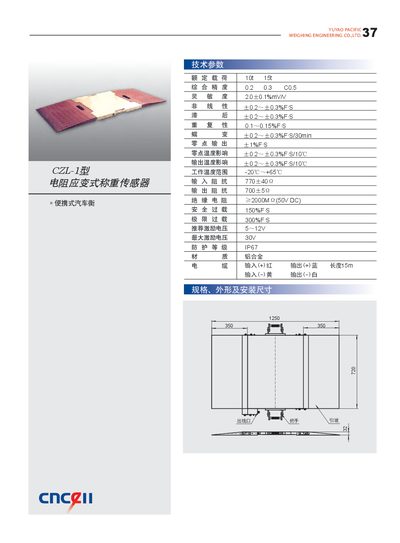
The CZL-1 resistance strain weight sensor is designed for high‑precision weighing applications. It offers a rated load of up to 15 t and features comprehensive accuracy between 0.2 % and 0.3 % of full scale.
Key performance figures include a sensitivity of 2.0 µV/V, non‑linearity, hysteresis and repeatability within 0.2‑0.3 % F.S, and a zero‑point output tolerance of 1 % F.S. The sensor operates from –20 °C to +65 °C, has IP67 protection, and supports excitation voltages from 5 V to 12 V (maximum 30 V). This manual is written in Chinese.
| Rated load | 15 t |
|---|---|
| Comprehensive accuracy | 0.2‑0.3 % F.S |
| Sensitivity | 2.0 µV/V |
| Non‑linearity | 0.2‑0.3 % F.S |
| Hysteresis | 0.2‑0.3 % F.S |
| Repeatability | 0.1‑0.15 % F.S |
| Operating temperature range | -20 °C to +65 °C |
| Recommended excitation voltage | 5 V‑12 V |
| Maximum excitation voltage | 30 V |
| Protection rating | IP67 |
The CZL-1 sensor is rated for a maximum load of 15 t.
A recommended excitation voltage of 5 V to 12 V should be applied, with a maximum of 30 V.
The sensor has an IP67 protection rating.
It can operate from –20 °C up to +65 °C.