
The document describes the features and characteristics of the Photologic® reflective object sensors produced by OPTEK, including mounting configurations, output configurations, electrical output, PCB mounting, and wire length. The product can be used for non-contact object sensing, assembly line automation, machine automation, and other applications.
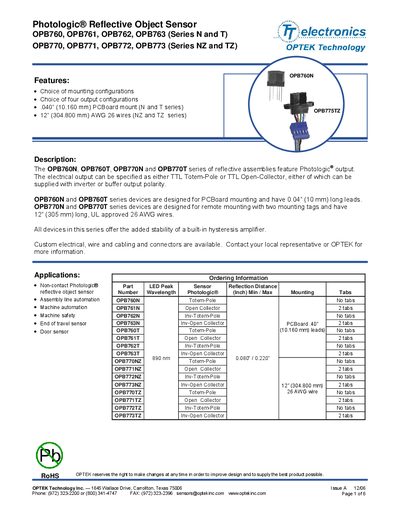
The OPTEK Photologic® Reflective Object Sensor series includes the OPB760, OPB761, OPB762, OPB763 (Series N and T) and the OPB770, OPB771, OPB772, OPB773 (Series NZ and TZ). These sensors provide either TTL Totem‑Pole or TTL Open‑Collector outputs with optional inverter or buffer polarity and are available in PCBoard‑mount or remote‑mount configurations.
The document lists absolute maximum ratings, electrical characteristics, pin descriptions, and performance graphs such as logic level versus distance and temperature effects. It also notes optional custom wiring and connector options.
| Supply Voltage (Vcc) | 10 V (not to exceed 3 s) |
|---|---|
| Storage Temperature Range | -40 °C to +85 °C |
| Operating Temperature Range | -40 °C to +70 °C |
| Lead Soldering Temperature | 260 °C (1/16" / 1.6 mm for 5 s) |
| Input Diode Forward Voltage | 1.8 V (IF=40 mA, Ta=25 °C) |
| Output Photologic Power Dissipation | 200 mW |
| Total Device Power Dissipation | 300 mW |
| Voltage at Output Lead (Open Collector) | 35 V |
| Diode Reverse Voltage | 3 V |
The sensor may be powered with up to 10 V, but the voltage must not exceed three seconds.
The device can be stored from –40 °C to +85 °C and operated from –40 °C to +70 °C.
Both TTL Totem‑Pole and TTL Open‑Collector outputs are offered, with optional inverter or buffer polarity.
N/T series devices use 0.04 in (10 mm) PCBoard leads, while NZ/T series devices have 12 in (305 mm) UL‑approved 26 AWG wires with standard connectors.