
This document describes the features and characteristics of the IPI60R600CP CoolMOSTM power transistor, including the lowest R ON x Qg value, ultra-low gate charge, extreme dv/dt rating, high peak current capability, and more.
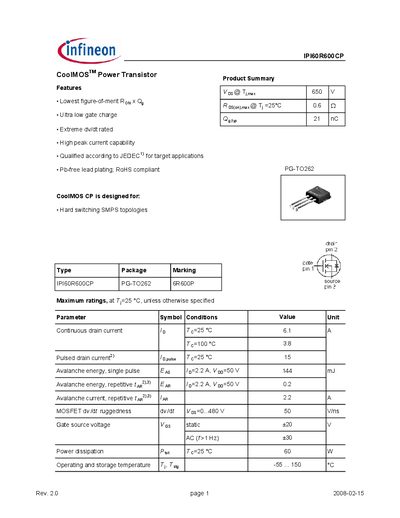
This datasheet presents the technical specifications of the Infineon IPIGOR600CP CoolMOS power transistor, including maximum ratings, thermal characteristics, and electrical parameters. It also contains characteristic curves for output behavior, gate charge, and diode switching.
The document includes detailed tables for continuous and pulsed drain currents, on‑state resistance, gate threshold voltage, thermal resistance, and avalanche energy, as well as package dimensions and compliance information.
| Continuous drain current (Id) | 6.1 A |
|---|---|
| Pulsed drain current (Id,pulse) | 15 A |
| On‑state resistance (Rds(on)) typical at 25 °C | 0.54 mΩ |
| Power dissipation (Pd) at 25 °C | 60 W |
| Junction‑to‑case thermal resistance (Rjc) | 2.1 K/W |
The maximum continuous drain current is 6.1 A at 25 °C.
The typical on‑state resistance is 0.54 mΩ at 25 °C.
The device can dissipate up to 60 W at a case temperature of 25 °C.