
The document describes the working principle and features of Philips air purifier. The air purifier removes harmful gases, odors, bacteria, viruses, and dust particles from the air through multiple stages of filtration and cleaning processes. Additionally, it can sterilize bacteria and viruses and clean the air of particles. The product is suitable for removing kitchen fumes, decoration fumes, cigarette smoke, animal odors, traffic fumes, bacteria and viruses, dust mites, pollen, and hair.
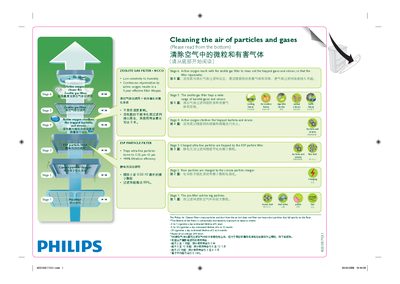
This guide describes the six-stage filtration system used in the Philips air purifier. Stage 1 captures large particles with a pre‑filter, Stage 2 charges finer particles using a corona charger, Stage 3 traps ultra‑fine particles with an ESP filter, Stage 4 sterilises bacteria and viruses with active oxygen, Stage 5 removes harmful gases and odours with a zeolite gas filter, and Stage 6 continuously rejuvenates the filter using active oxygen.
The manual also provides information on filter lifespan, noting a five‑year effective life under normal use, and explains how exposure to tobacco smoke can dramatically shorten that period. Maintenance instructions and filter‑replacement recommendations are included.
| Particle size range | 0.02 µm‑10 µm |
|---|---|
| Filtration efficiency | >99 % |
| Effective filter lifespan | 5 years (normal use) |
| Humidity sensitivity | Low sensitivity to humidity |
The ESP particle filter traps ultra‑fine particles down to 0.02 µm and up to 10 µm.
The filter provides an effective lifespan of about five years when used under normal conditions.
Exposure to tobacco smoke shortens the filter life: 0‑1 cigarette per day reduces it to about five years, 5‑10 cigarettes to 6‑12 months, and 20 cigarettes to 3‑6 months.
Stage 4 uses active oxygen to sterilise the trapped bacteria and viruses.