
Shanghai Barcode Network is a professional enterprise engaged in the sales and service of bar code technology application products. It mainly operates bar code printers, label printers, data acquisition devices, carbon tapes, labels, inventory machines, bar code scanners, bar code software, etc.
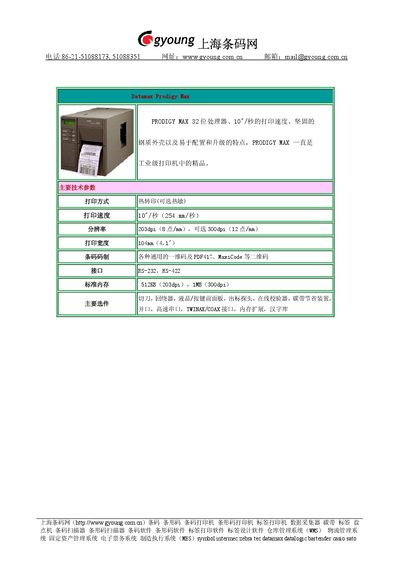
The Prodigy Max is an industrial‑grade barcode printer featuring a rugged steel housing, a 32‑bit processor, and easy configuration and upgrade options. It is marketed for high‑speed, reliable label printing in demanding environments.
Key technical parameters include thermal‑transfer (optional thermal) printing, a print speed of 10" per second (254 mm/s), resolutions of 203 dpi (8 dots/mm) or 300 dpi (12 dots/mm), a printable width of 104 mm (4.1"), support for a wide range of 1‑D barcodes and QR‑style codes such as PDF417 and MaxiCode, RS‑232 and RS‑422 interfaces, and standard memory of 512 KB (203 dpi) or 1 MB (300 dpi). This manual is written in Chinese.
| Printing method | Thermal transfer (optional thermal) |
|---|---|
| Print speed | 10"/sec (254 mm/s) |
| Resolution | 203 dpi (8 dots/mm) or 300 dpi (12 dots/mm) |
| Print width | 104 mm (4.1") |
| Supported barcode symbology | Various 1‑D codes, PDF417, MaxiCode |
| Interfaces | RS‑232, RS‑422 |
| Standard memory | 512 KB (203 dpi) or 1 MB (300 dpi) |
The printer can print at 10 inches per second, which equals 254 mm per second.
It uses thermal‑transfer printing and can optionally use thermal printing.
The device provides RS‑232 and RS‑422 serial interfaces.
The printer can achieve up to 300 dpi (12 dots per mm).