
BT136 series D logic level triacs are characterized by high reliability, high voltage, low power consumption and low junction temperature, suitable for general purpose bidirectional switching and phase control applications.
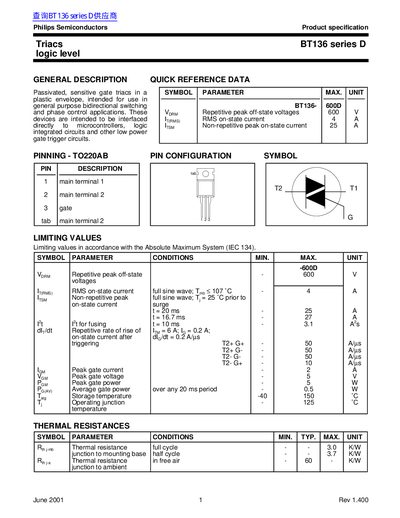
This document is a product specification for the BT136 Series D, a passivated, sensitive gate triac designed for general purpose bidirectional switching and phase control applications. The device is intended for direct interfacing with microcontrollers, logic integrated circuits, and other low power gate trigger circuits.
| Repetitive peak off-state voltage | 600 V |
|---|---|
| RMS on-state current | 4 A |
| Non-repetitive peak on-state current | 25 A |
| Thermal resistance junction to ambient | 60 K/W |
| Gate trigger current (T2+ G+) | 5 mA |
| On-state voltage | 1.70 V |
The maximum repetitive peak off-state voltage is 600 V.
The maximum RMS on-state current is 4 A when the junction temperature is below 107 °C.
The maximum permissible RMS on-state current in free air depends on the mounting base temperature, as shown in Figure 4.