
The document describes the features and characteristics of Philips Semiconductors' BT136 series Triacs, including high bidirectional transient and blocking voltage capability and high thermal cycling performance. It is intended for use in applications requiring high voltage capability and high thermal cycling performance, such as motor control, industrial and domestic lighting, heating, and static switching.
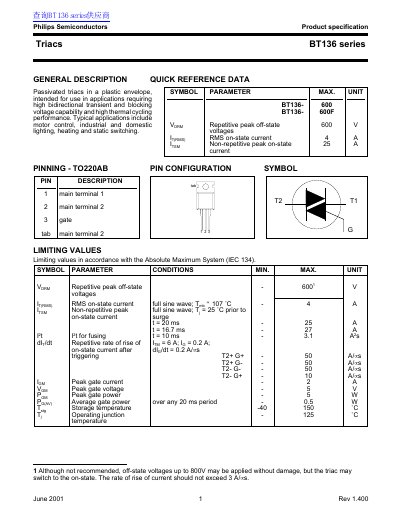
This document is a product specification datasheet for the Philips BT136 series of triacs. These are passivated triacs housed in a plastic envelope, designed for applications requiring high bidirectional transient and blocking voltage capabilities. Typical uses include motor control, industrial and domestic lighting, heating, and static switching.
| RMS on-state current | 4 A |
|---|---|
| Storage temperature | -40 to 150 C |
| Package type | TO220AB |
The maximum gate trigger current (IGT) is 70 mA for the T2- G+ quadrant.
The maximum RMS on-state current is 4 A.